Inside Curious Minds
Guest Profile
Guest Brief
J. Doyne Farmer
Physicist · Chaos Theorist · Complexity Economist · Entrepreneur
"The economy is a complex system. Treat it like one."
Life arc · key inflection points
🎰
1975–80
Roulette &
Chaos Theory
Chaos Theory
⚛️
1981–90
Los Alamos &
Santa Fe Inst.
Santa Fe Inst.
📈
1991–99
Prediction Co.
Quant Trading
Quant Trading
🏛️
2012–now
Oxford &
Macrocosm
Macrocosm
Fast facts
BornHouston, TX · raised Silver City, NM
BSPhysics, Stanford University, 1973
PhDPhysics, UC Santa Cruz
NowBaillie Gifford Prof., Oxford; External Prof., Santa Fe Inst.
BookMaking Sense of Chaos (Allen Lane, 2024)
Co.Macrocosm Inc., Chief Scientist
BoardForest Guardians (since 1996, pres. 2001)
6 core themes
Chaos & prediction
Science as adventure
Markets as ecosystems
Reinvention
Green transition
Technology & society
Key contributions & innovations
👟
The Roulette Shoe Computer
World's first wearable digital computer. Hand-coded in machine language; toe switches, vibrating outputs. Achieved ~20% edge over the house in Las Vegas.
1977 · Eudaemonic Enterprises
🌀
Chaos Theory & Dynamical Systems
Co-founded the UC Santa Cruz Dynamical Systems Collective — one of the first groups to formalise chaos theory as a science, predating its mainstream discovery.
1978–81 · UC Santa Cruz
🤖
Automated Quantitative Trading
Co-founded Prediction Company — one of the world's first fully automated quant trading firms. Applied physics-inspired ML to financial markets. Acquired by UBS in 2006.
1991 · Prediction Company
🧬
Market Ecology Theory
Developed the theory that financial trading strategies behave like biological species — competing for resources, forming food webs, and shaping each other's size and profit.
2000s · Santa Fe Institute
☀️
Technology Cost Forecasting
Built models correctly predicting the dramatic collapse in solar energy costs years before mainstream economists believed it possible — using complexity-based scaling laws.
2010s · Oxford Martin School
🌍
Complexity Economics
Pioneered treating the economy as a complex adaptive system — with agent-based models, emergent behaviour, and evolutionary dynamics — rather than equilibrium mathematics.
Ongoing · Oxford / Macrocosm
Fields & influence
Chaos theoryCo-pioneered with Packard, Crutchfield et al. at UCSC in the late 1970s.
Wearable computingBuilt the first wearable digital computer, ahead of Apple I.
EconophysicsBrought statistical physics tools to financial markets; helped found the field.
Complexity economicsDirects the programme at Oxford's INET, challenging neoclassical orthodoxy.
Energy forecastingHis scaling-law models predicted solar cost collapse; now applied to the green transition.
🎙️ New Episode — Watch the Conversation
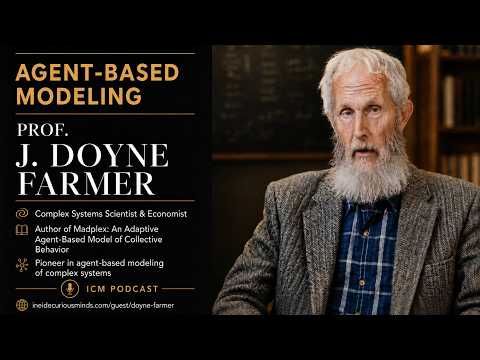
▶
Inside Curious Minds
Complexity Economics & Chaos Theory
J. Doyne Farmer in conversation
🎬 Recorded June 26, 2026
Agent-Based Modeling
What sets Farmer's approach apart from traditional economics
Bounded Rationality
Traditional Econ
Agents are perfectly rational Homo Economicus — infinite computing power, full information, and Rational Expectations (they effectively know the future).
Farmer's ABM
Agents have bounded rationality — limited information, limited cognitive capacity, and use simple, transparent heuristics. This makes the model highly explainable, unlike black-box neural networks.
Out-of-Equilibrium Dynamics
Traditional Econ
Assumes the economy naturally settles into a stable equilibrium — a state of rest where supply meets demand and nothing changes.
Farmer's ABM
The economy is a Complex Adaptive System that is never in equilibrium. It constantly evolves, crashes, and adapts. Models are designed to capture crises, bubbles, and endogenous instability — not just steady states.
Network Topologies & Contagion
Traditional Econ
The "environment" is a blank space — agents interact anonymously through a centralised price vector with no explicit connection structure.
Farmer's ABM
In climate-economy models (Macrocosm), the environment is a highly structured Input-Output Network. If Agent A (a microchip factory) is hit by a climate shock, the shock propagates through specific network links to Agent B (a car manufacturer).
Empirical Calibration & Stylized Facts
Traditional Econ
Models are built on mathematical axioms and assumptions; calibration is secondary and often limited to a handful of aggregate parameters.
Farmer's ABM
Agents' decision rules are calibrated using real-world microdata. The model is validated by checking whether emergent macro-behaviour reproduces real-world "stylized facts" — fat-tailed stock returns, Pareto wealth distributions, and other empirical regularities.
The BEAST Framework
Traditional ABMs
Standard Python / C++ agent-based models are computationally prohibitive for national-scale models with tens of thousands of heterogeneous agents.
Farmer's ABM
His team developed BEAST (Big and Efficient Agent-based Simulation using Tensors), mapping agent interactions onto GPU tensor operations — enabling simulation of 30,000 firms and 160,000 assets in a fraction of the time.